

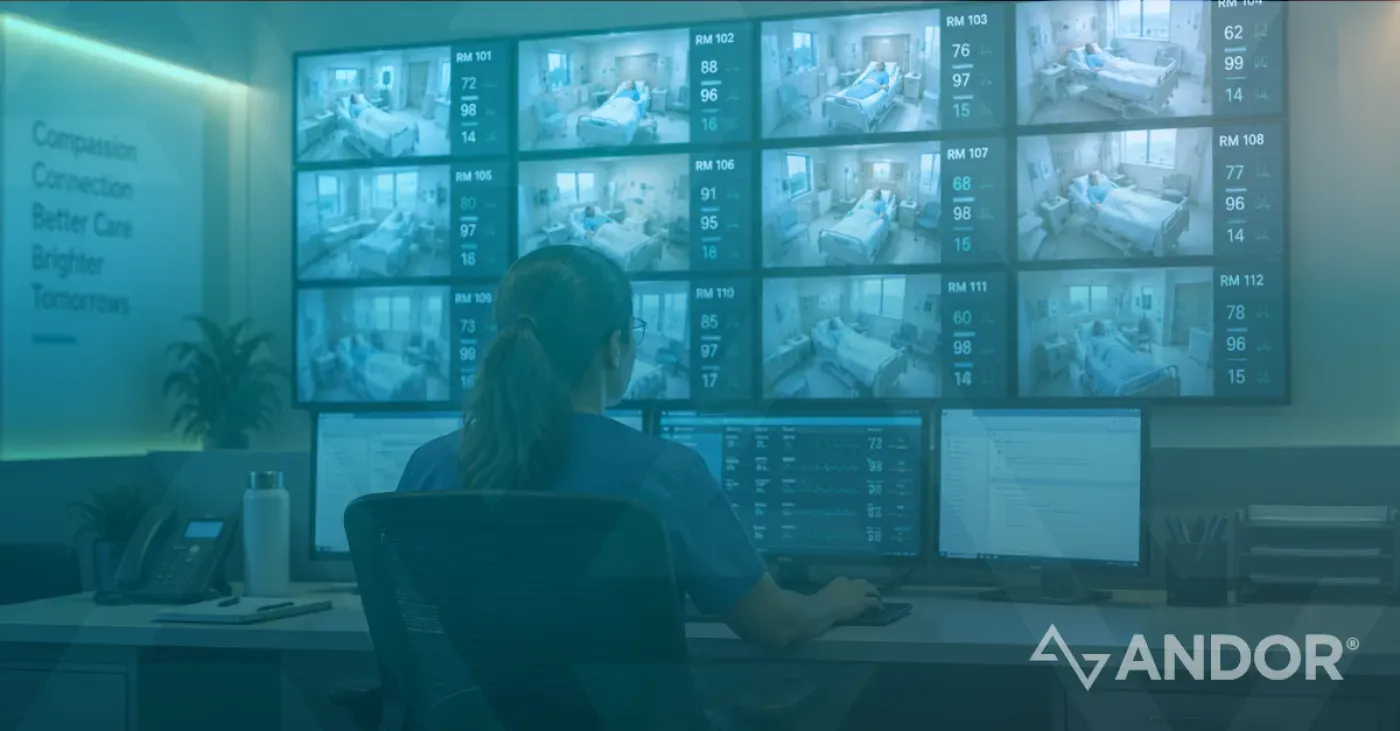
Walk into a hospital at three in the afternoon, and the clinical work is everywhere at once. A patient discharged this morning needs a follow-up call inside forty-eight hours. A monitored heart-failure patient at home just crossed a weight threshold. An admission is stalled because no one has finished the paperwork. A behavioral health consult is waiting. Each of these is a discrete piece of clinical work with a clock on it, and in most organizations the person who should do it finds out late, if at all. The work sits in a queue, a pager, an inbox, or someone's memory.
Pritesh Patel, president and chief operating officer of Andor Health Ventures, describes the problem in terms he borrows from aviation. "An airport does not run because every pilot is good at flying," he says. "It runs because one tower can see every aircraft, knows which runways are open, and tells each plane exactly when and where to move. Clinical work has plenty of skilled pilots. What it has almost never had is the tower."
That tower, the command center that sees all the work and routes each task to the right available resource in real time, is what Patel spends his time building. It is also, he argues, the part of the model that outsiders miss when they look at a company that runs both an AI platform and a clinical workforce.
Seeing the work before a human has to
Routing starts with detection. Before any task can be assigned, the system has to know the task exists. In a traditional setup, that knowledge is human and it is slow. A nurse notices a vital sign. A coordinator remembers a discharge. A physician catches an abnormal result on the next chart review. The gap between when work becomes necessary and when a person realizes it is where patients fall through.
Andor Health's architecture closes that gap by letting software watch the signals continuously. Event notifications, monitoring feeds, admission and discharge data, and remote patient devices generate a live stream of clinical work as it arises. The AI agent layer reads that stream. When a monitored patient crosses a threshold, when a discharge is recorded, when an admission needs documentation, the work is identified the moment it appears rather than the next time a human happens to look.
"The first job of the tower is not to move anyone," Patel says. "It is to know, at every second, everything that needs to happen. You cannot route work you cannot see. Most of healthcare is still finding out about the work by accident."
Routing to the right available resource
Detection alone changes nothing if the task lands on someone who is busy, off shift, or the wrong fit. The second function of the command center is matching. Each identified task carries attributes: what kind of work it is, how urgent, what license or skill it requires, which patient and which program it belongs to. The workforce carries its own attributes: who is on, what they are trained for, what they are already handling, and how much headroom they have right now.
The routing engine reads both pictures and puts each task with the resource that can act on it soonest and best. A transitional care outreach call goes to a care coordinator with room on the schedule. An abnormal remote-monitoring reading that needs a clinical judgment goes to a nurse or an advanced practice provider licensed in that state. Documentation work an agent can complete goes to the agent, not to a clinician who would otherwise spend the time. The point is not to keep people busy. It is to make sure no piece of work waits for a person who was never going to get to it.
This is where running the technology and the workforce as one unit matters. A software vendor can build a beautiful routing screen, but it hands the screen to a customer whose staff it does not control. A staffing firm can send capable people, but it has no live view of the work to route them against. Because Andor Health operates both layers, the same system that sees the work also directs the people and the agents who do it. "The routing is only real if you control what is on both sides of it," Patel says. "The demand and the supply. If you only own one, you are guessing about the other."
One control point, everything visible
The third piece is visibility. A control tower is useless if each controller can only see a slice of the sky. In clinical operations, the equivalent failure is a dozen separate tools, each holding one program's work, none of them talking. The remote-monitoring platform knows its patients. The discharge system knows its discharges. The behavioral health line knows its consults. No one sees the whole board.
The command center is built as a single control point across service lines. From it, a supervisor can see every open task, where each one sits, how long it has waited, and which resource is on it. Work that is aging toward a deadline surfaces before it breaches. A task that was routed to someone now unavailable is rerouted. Because Andor Health runs more than thirty clinical service lines on the same infrastructure, that view is not confined to one program. Transitional care, remote monitoring, virtual nursing, and behavioral health all appear on the same board, which is what lets the system move a resource from a quiet line to a busy one when the day demands it. The board is not limited to the company's own people. A hospital's care managers, discharge planners, and floor nurses sit on it alongside the virtual team, which is the point. Nothing is being taken out of the system's hands. For the first time, the system can see all of the work in one place and put the nearest capable person on it, whoever employs them.
Patel is careful about what the tower is and is not. "The tower does not fly the plane," he says. "Our clinicians make the clinical calls, every time. What the system does is make sure the right clinician is looking at the right patient at the right moment, with nothing lost in between. That is an operations problem, and it is one healthcare has tolerated being bad at for a very long time."
Why this is the operating spine, not a feature
It would be easy to file all of this under workflow software. Patel resists that framing. Routing and visibility are not a feature bolted onto a product. They are the operating spine of a company that has agreed to own the result rather than sell a tool and wish the customer well. When an organization stands behind an outcome, a follow-up completed on time, a deterioration caught early, a discharge that does not become a readmission, it can only do so if the underlying work reliably reaches the right hands. The command center is how that reliability is manufactured.
The elastic side of this, how the same routing model absorbs surges and lets capacity flex with demand, is its own subject. So is the question of how you keep a distributed workforce consistent, and what you choose to measure once you are accountable for the whole system. The routing model is the foundation those rest on. Get the tower right, and the work finds the resource. Get it wrong, and no amount of talent on either side rescues the patient waiting in the queue.
Patel keeps returning to what the absence of a tower costs. "Healthcare has no shortage of good pilots," he says. "What it does not have is anyone who can see the whole sky at once and move a resource against it in real time. So the work waits for somebody to notice, and the patient waits with the work." Building the tower is slow, and it wins no awards. It is also what separates a collection of clinical programs from an operation that can be held to a result.