

Blogs

FCC Second Round Funding Application Window is Open
April 30, 2021
An additional $249.95 million was provided as part of the Consolidated Appropriations Act (CAA) to fund a second round of the COVID-19 Telehealth Program. The FCC appointed Universal Service Administrative Company (USAC) as administrator of the Program’s second round and released the details in a Report and Order statement.
The application filing window for the second round of funding opened Thursday, April 29, 2021 and will close on Thursday, May 6, 2021, at noon EST. With team members experienced in submitting grant applications, Andor Health is here to help and can provide complimentary assistance with writing your application.
Both rural and non-rural health clinics are eligible to receive funding, including nonprofit and public eligible healthcare providers that fall within the categories of healthcare providers in section 254 (h)(7)(B) of the 1996 Telecommunications Act.
- Post-secondary educational institutions offering healthcare instruction, teaching hospitals, and medical schools
- Community health centers or health centers providing healthcare to migrants
- Local health departments or agencies
- Community mental health centers
- Not-for-profit hospitals
- Rural health clinics
- Skilled nursing facilities
- Consortia of healthcare providers consisting of one or more entities falling in to the first seven categories
To apply to the COVID-19 Telehealth Program, you will need to:
- Request an eligibility determination from USAC by filing an FCC Form 460
- Obtain an FCC Registration Number (FRN) and an FCC Commission Registration System (CORES) ID
- Register for a System for Awards Management (SAM) account
NOTE: Some steps take a week or more to complete and we highly recommend you begin these processes immediately.
For additional information regarding second round funding, please refer to the Universal Service Administrative Company’s website.
Bala Thirumalainambi
Sr. Director, Interoperability & Healthcare Policy
Learnings from the ER: Building Sustainable Virtual Health with AI
April 1, 2021
“We’re seeing a need for accessing data in real time both from a clinical perspective and an operational perspective in and across the health care system…to provide insights on patient care as well as how we run the hospitals.” Peter Jones, Healthcare Industry Lead, Microsoft Canada
Download this free webinar from Andor Health and Microsoft.
Learn how to build a sustainable virtual health strategy, while transforming care collaboration with AI from:
- Joshua Briscoe MD, FACEP;
- Noel Khirsukhani, Chief Growth Officer, Andor Health; and
- Peter Jones, Healthcare Industry Lead, Microsoft Canada.
This team of healthcare and technology experts discuss how the ‘new normal’ in virtual healthcare is maturing and the strategies Canadian healthcare providers should be considering when configuring virtual visits beyond the video call.
This session explores perspectives from both clinicians and technologists when orchestrating sustainable virtual health strategies including configuring self-service scheduling, virtual waiting rooms, multi-specialist consultations and post visit follow-up.
As AI capabilities become the key differentiator in sustaining virtual care into the future, this webinar also focuses on how AI infused capabilities are powering virtual rounding, collaboration and communication between clinicians and the acceleration of time-to-treatment by:
- Empowering health care teams to collaborate and coordinate care in real-time
- Configuring and contextualizing secure access to patient health information through AI bots
- Reducing clinician burnout through automated patient workflows.
Watch the webinar here.

Sustainable Virtual Health and the New Normal
March 31, 2021
It’s been a year of upheaval most of us are anxious to forget; but despite the challenges of the COVID-19 pandemic, important lessons have emerged. Some of the changes to our ‘normal’ way of life were for the better and should be cultivated. The increased time at home with family and loved ones, cleanliness of public spaces including eating establishments, and the elevated respect for personal space are a few positive attributes of the ‘new normal.’
As a board-certified practicing physician, I’ve also seen first-hand how the rapid acceleration of virtual collaboration and communication in healthcare in the form of virtual health visits have transformed people’s lives for the better; for both providers and patients alike. We have learned that implementing a smart and sustainable virtual health platform allows for consistent delivery of high-quality, cost effective, and more efficient patient care – ultimately leading to more opportunities for healthier living.
In the past year, some health tech organizations have made great strides in virtual health workflows, virtual waiting room capabilities and the important ability to integrate these experiences with the electronic health record, all with the goal of driving higher quality outcomes. There is still much opportunity for virtual health and its full potential to be realized with solutions that take the virtual visit beyond a simple video call. Patients have come to expect the same convenient and flawless experience that they’re accustomed to in the consumer world. To deliver on this very appropriate expectation, providers and care teams need technology solutions that fit snuggly into clinicians’ natural workflow, while navigating patients’ continuum of care without attempting to change the natural process.
Historically clinicians have been asked to change their workflow to accommodate new technology, instead of receiving well-designed solutions created to enhance how they work. Those who create extensible solutions listen first and then design to accommodate. Sustainable technology based in a design-thinking approach enables a repeatable platform that can be leveraged across numerous use cases, increases satisfaction, and improves time to service. In certain scenarios it’s a matter of convenience and an efficient mode of patient care, in others it allows for treatment that otherwise would have been missed.
Sustainable virtual health strategies can drive the transformation of healthcare and how care is delivered going forward. Not only does it enhance patient and provider interactions, but it empowers clinical collaboration, allowing better access to specialists who can offer expert guidance. Clinicians are masters in their fields, but some diagnoses have treatments that are better applied in conjunction with a specialist or colleague with unique expertise. With virtual health, we include patients directly in these conversations, but also integrate caregivers or family members to contribute to shared decision making.
A year into this life changing pandemic, indeed much has been altered and much has been lost; but amidst this hardship, ingenuity and opportunity have also flourished. Let’s be sure to keep this momentum going and continue the transformation of healthcare for the better.
Connecting Customers and Businesses with Azure Communication Services and Microsoft Teams
March 31, 2021
Last year, Microsoft launched Azure Communication Services to help businesses reach customers—enabled by voice, video, text chat, and connections into short message service (SMS) and public switched telephone network (PSTN)—across applications, websites, and mobile platforms. Since launch, they have onboarded hundreds of customers and partners into preview across multiple industries and look forward to supporting more with general availability later this month. From retailers looking to enhance remote customer engagement, to banks and financial institutions needing to use mobile authentication and notification technologies, Azure Communication Services is making the development of intelligent, secure, and global communication experiences simple with just a few lines of code.
In this new hyper-connected world, where most of our interactions are digital, even the smallest snag during a virtual visit or appointment can impact user satisfaction and retention. Delivering better customer experiences by eliminating the friction that often comes with connecting users on different platforms can help improve business outcomes and increase productivity.
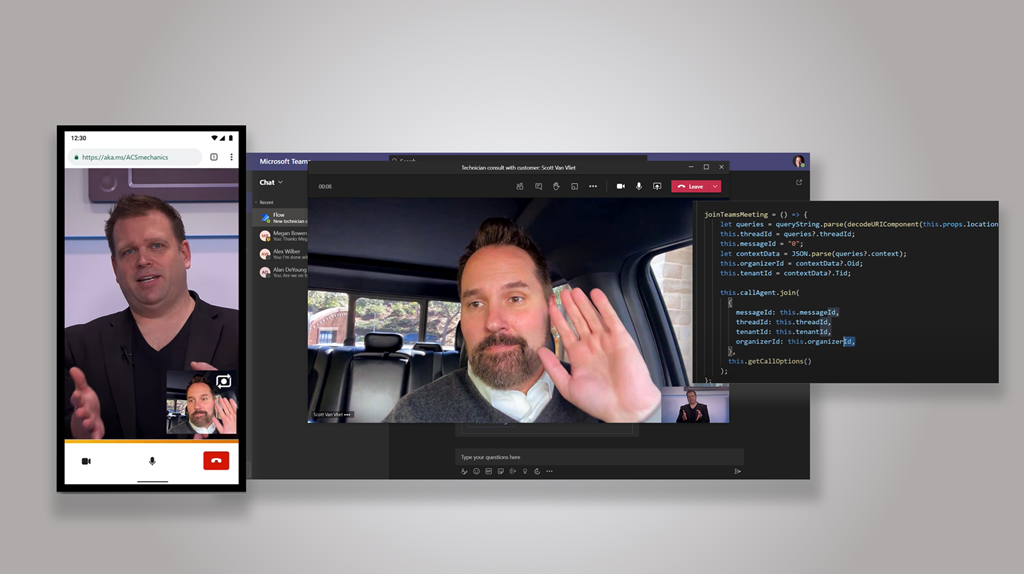
Businesses can now use Azure Communication Services to easily connect users of their custom-built app with internal users on Microsoft Teams via voice, video, or chat. This means customers can connect to employees using Teams without any app download or required authentication while employees retain the familiar interface of their Microsoft 365 ecosystem, the place where they already collaborate, communicate, and work every day.
Microsoft Mechanics: Azure Communication Services | Build video, voice and chat app (2021)
Extending Microsoft Teams with Azure Communication Services can benefit businesses in a variety of scenarios, such as a financial advisor helping a client with a loan application, a customer support agent assisting end-users in installing a new product, or a healthcare organization enabling faster response times between a patient and provider. Imagine launching a video call or chat with an advisor, agent, or clinician in just one-click. You experience none of the regular barriers, like needing to create a new account or download a new app. With the number of virtual video clinician visits expected to surpass 400 million globally this year1, offering the ability to instantly connect a clinician using Teams to a patient using a hospital website can help make a virtual visit feel effortless and welcoming. With interoperability into Teams, it is simpler than ever for businesses to stay closer to and more connected with their customers.
Microsoft has been working with several organizations that are building out experiences using Azure Communication Services and Microsoft Teams and are anticipating the benefits in a variety of use cases.
"The new normal in healthcare is being driven by innovations in care delivery that empower the patient and provider experience, rarely impeding it. As an Azure Communication Services development partner, Andor Health is positioned to deliver a simple, intuitive virtual health experience via the patient's platform of choice. Patients of almost all technical abilities can seamlessly participate in Microsoft Teams-based virtual health visits with a simple click and without having to download Teams or any other app. This ubiquitous access is expected to significantly improve care continuity and outcomes by removing the technological barriers that contribute to virtual health abandonment rates, allowing providers to increase their patient load while maintaining the highest standards of care."—Drew Jenkel, Chief Architect, Andor Health
"At Luware, we have a passion for developing software that enables exceptional customer interactions. Whether it's virtual banking, sales assistance through video, or live chats within a company's e-commerce app, businesses today have a tremendous opportunity to deliver convenient, remote customer service. Partnering with Microsoft and using Azure Communication Services for our development allows us to incorporate Microsoft services into our customer service suite 'Nimbus', empowering companies to truly realize their multichannel strategy with Microsoft Teams as their central communication tool."—Philipp Beck, CEO, Luware
For any organization or business looking to get more value out of their Microsoft Teams investments, interoperability with Azure Communication Services provides the flexibility and scalability needed to build custom app experiences that connect to the Teams platform. As a bonus, with Azure Communication Services on the backend, usage costs from Teams endpoints are covered under any Microsoft 365 license.
Building customizable communication experiences across multiple platforms will continue to be an integral part of any business process for modernizing collaboration. With Azure Communication Services, the goal is to continue to help businesses transform their communication experiences today to meet the needs of these connected users for tomorrow.
This article by Scott Van Vliet, Corporate Vice President, Intelligent Communications at Microsoft, was originally published on the Microsoft Azure Blog.

Welcoming Andor Health to the M12 Portfolio
March 31, 2021
By Priyanka Mitra, M12
I am very excited to welcome Andor Health, a company that harnesses machine and human intelligence to change the way care teams connect and collaborate with patients, to the M12 portfolio as their sole Series A investor.
The global pandemic has forced an important focus on the healthcare industry and the infrastructure that supports it. While COVID-19 has introduced new complexity to our existing healthcare systems, even basic healthcare interactions and transactions are far from simple. For example, in the backdrop of a standard provider-patient appointment, there are dozens of discrete tasks that must take place before, during, and after the appointment to ensure that the patient receives the care they need. These tasks include paperwork processing; on-the-spot data entry; and follow-ups with specialists, to name a small handful. Unfortunately, the complexity of multiple stakeholders and varied processes creates a minefield of potential — and costly — mistakes. The US healthcare economy leaks an estimated $1–2 trillion annually in issues related to patient encounters. With physician burnout at an all-time high, the magnitude of physician-patient encounter mistakes could become even larger, negatively impacting patient care and the bottom line alike.
Andor Health is taking this challenge head-on with a software solution designed to solve several of the costly, systemic problems surrounding patient-physician appointments. Unlike several other digital health platforms that tackle a discrete element of end-to-end workflow, Andor considers the holistic experience of physician-patient encounters and the relevant, required IT tasks. Their end-to-end clinical care orchestration provides digitization, automation, and integration infrastructure to streamline the tasks that occur before, during, and after a patient encounter. Andor Health’s software gives physicians more time to meaningfully focus on patient care and enables collaboration and communication between care teams.
The team behind this solution is truly world class. Prior to founding Andor Health in 2018, CEO Raj Toleti spent 20+ years as a healthcare IT entrepreneur. He and his executive team have collectively spent over six decades thinking deeply about the healthcare IT challenges that inhibit the patient journey, and boast successful exits of patient engagement, registration, and medical payments companies. Andor Health’s founding team intimately understands healthcare IT workflow and are innovating against the technical challenges to realize the ideal physician and patient experience.

Customers of Andor Health’s solution are already seeing meaningful ROI — patients are missing fewer virtual visits thanks to the virtual visit/virtual health alert system, and physicians are saving time on clicking through screens and reviewing charts during their patient visits with the help of the Andor platform, allowing for more present and empathetic conversations.
I’m passionate about the cause of reducing physician burnout and improving the patient experience, and I’m inspired by Andor Health’s work in service of this cause to date; I’m excited to take on a Board Director position with the company. Congratulations to Andor Health on this fundraise, and welcome to the M12 portfolio! We look forward to your continued growth.